
When faster isn't better: rethinking delivery speed in e-commerce
Delivery speed isn't the only variable that matters in e-commerce. Here's what smart retailers are doing to give customers more control over their delivery choices.
LOGISTICS AND SUPPLY CHAIN
Kate Narey
7/9/20263 min read
It's not just 3DJake
Once you start looking, the same idea is appearing across the industry in different forms.
Amazon has "Amazon Delivery Days," which let customers group orders for the week into a single delivery. They also offer a "no rush" service with a small discount for choosing slower shipping. Sainsbury's grocery delivery slots display a green van icon when a vehicle is already going to the customer's area, with no incentive beyond the visual cue itself. Zooplus has been offering similar options to pet food customers.
Different retailers, different mechanisms, same principle. Give the customer a low-friction way to opt into slower, cheaper, more sustainable delivery. Trust them to make the choice that suits their situation.
The framing matters
more than the feature
The tick box itself isn't the interesting part. What matters is how the option is presented to the customer.
"Help us save costs" doesn't drive adoption. Customers don't feel a warm glow about helping a retailer's margin. But "help save the environment," "save money on your order," or even the small satisfaction of ticking a box that says you're not in a rush — those framings work, because they give the customer credit for making a good decision.
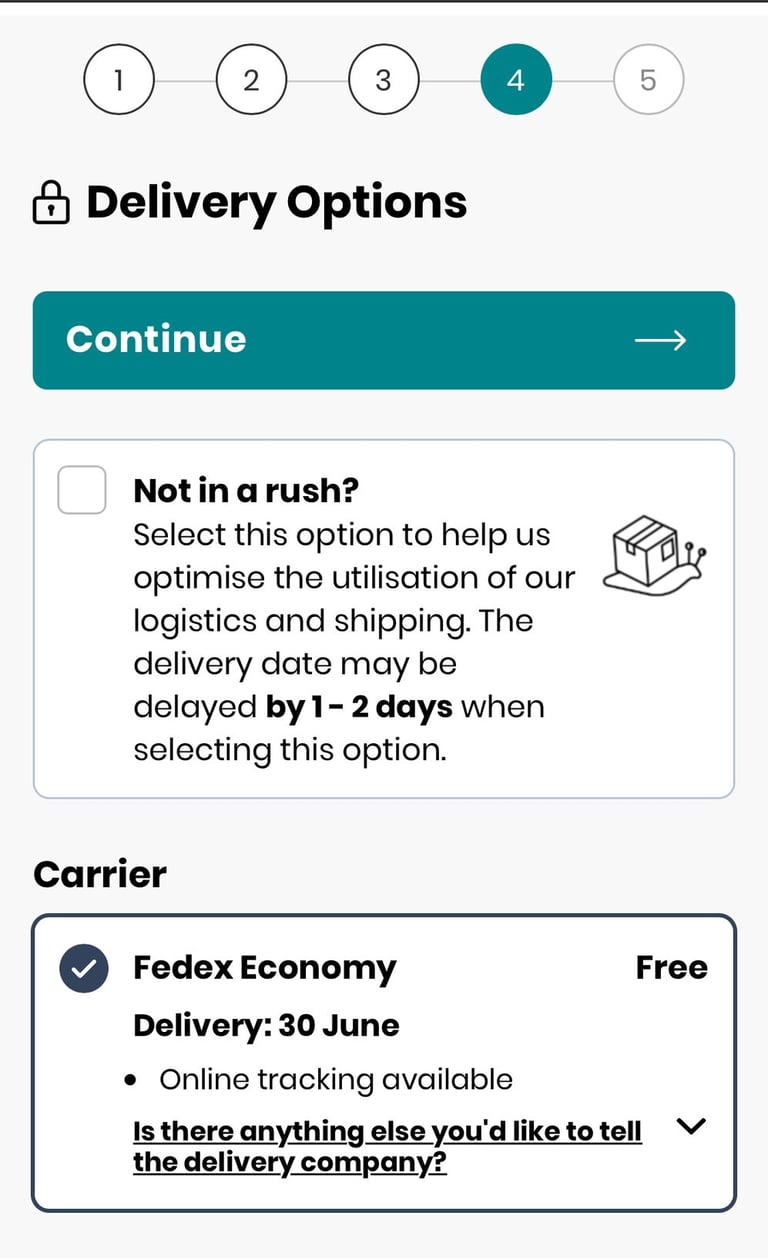
This is where 3DJake's execution stands out. They don't pretend the delay is a feature. They explain honestly that it helps them optimise logistics, and that the delivery date may shift as a result. The wording works because it's transparent. It invites the customer into a small act of shared decision-making rather than dressing up the retailer's benefit as their own.
Why this matters for
e-commerce and logistics
Most delivery decisions in e-commerce are made on the customer's behalf. The retailer picks a speed based on what they assume the customer wants, quotes accordingly, and the customer accepts whatever appears in the checkout flow. There's no space for the customer to say, actually, I'm ordering this as a gift for next month. Or, honestly, I can wait.
Giving the customer that choice does two jobs at once. It puts them back in control of their own experience, which builds trust. And it gives the logistics operation more flexibility to consolidate loads and plan around real demand.
For retailers running their own logistics, like Amazon and Sainsbury's, the case is even stronger. When you own the fulfilment operation end-to-end, every consolidated delivery is a direct cost saving. The bigger the operation, the bigger the return.
What smaller retailers
can take from this
Not every business has an Amazon-scale logistics operation to optimise. But the underlying principle applies at every scale. Ask the customer what they actually need. Give them the option to say slower is fine. Frame it in a way that flatters their choice rather than exposing your costs.
The retailers still treating delivery speed as the only variable that matters are optimising for one metric while ignoring several others. Faster isn't always what the customer wants. It's just what the industry has assumed they want.
That's a competitive edge waiting to be picked up by anyone willing to ask.
For years, e-commerce has treated delivery speed as a one-way pressure. Customers want it faster. Fulfilment scrambles to meet the promise. Retailers escalate their commitments with each new competitor. First it was next-day. Then it was same-day. The race gets more expensive every quarter, and the assumption behind it goes unexamined.
The assumption is that customers always want their orders as quickly as possible.
They don't.
I recently placed an order with 3DJake, a European retailer specialising in 3D printing supplies. At checkout, alongside the usual delivery options, was a small tick box I hadn't seen before: "Not in a rush?"
Selecting it delayed my delivery by a day or two so the retailer could group my order with others heading the same way. The benefits were laid out plainly: smaller carbon footprint, lower logistics costs, more breathing room in the fulfilment operation.
I needed my order fast that day, so I left it unticked. But the option stayed with me for a reason. It reframed the entire delivery conversation.

