
The brands worth remembering don't sound like everyone else
CONTENT MARKETING
Kate Narey
5/20/20262 min read
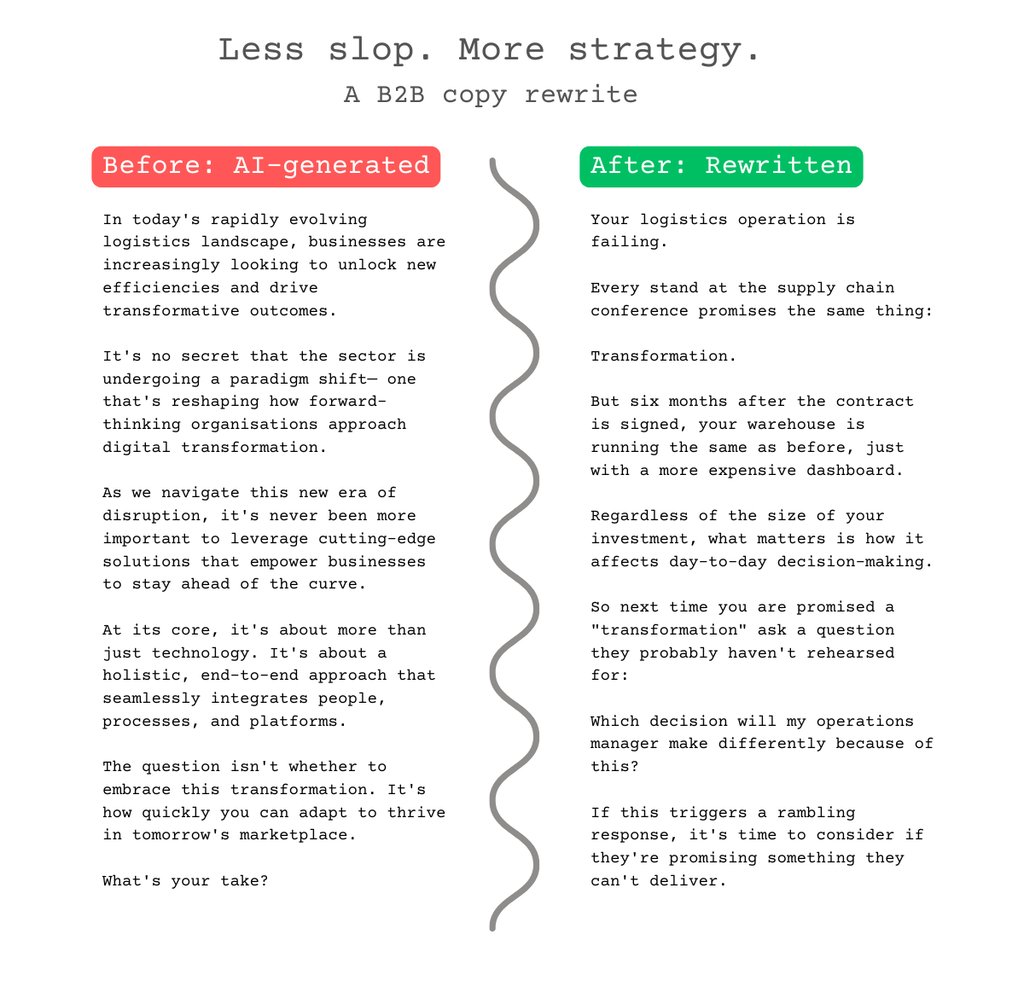
I spent this morning deliberately writing badly.
I wanted to see how many AI tropes I could pack into a single piece of B2B copy before it stopped sounding plausible. Turns out the answer is quite a lot, because "plausible" is exactly what AI is built to produce.
Then I rewrote it with the same topic but with the one thing the AI version was missing: a point of view.
You can see the comparison below.
What the AI version is actually doing
Read the left-hand column and ask yourself what it's saying. The honest answer is: not very much.
It mentions transformation. It mentions disruption. It mentions paradigm shifts and forward-thinking organisations and cutting-edge solutions. None of those words are wrong. But none of them are doing any work either.
What the AI version is really doing is performing competence. It sounds like the kind of thing that gets published in B2B logistics, so it will probably get published in B2B logistics. The reader skims it, registers that a piece of content exists, and moves on.
This is what some B2B content looks like in 2026. Not because writers can't do better, but because AI has made the low bar much, much cheaper to clear.
Why "plausible" isn't enough
AI is good at plausible. It will give you something that sounds like a thought leadership piece.
What it can't do is decide what the piece is for. It can't pick a position worth defending. It can't write a line that makes someone pause halfway through their morning scroll and think, "That's true, I hadn't seen it put that way before."
Those things still require a human. Specifically, they require a human who is willing to be a bit wrong in public, to make a claim someone could disagree with.
If you take those things out of B2B copy, you get the left-hand column, which is fine if your goal is to publish. It's a problem if your goal is to be read.
What the rewrite is doing differently
The right-hand column says one thing clearly. Most logistics transformation projects deliver software, not change. That claim could be argued with. It probably should be argued with by some readers. That's the point.
A reader who agrees has just had a vague suspicion put into words for them. A reader who disagrees has been given something to push back against, which is its own form of engagement. Either way, the piece has resonated.
The right-hand column also gives the reader a tool. The question at the end ("Which decision will my operations manager make differently because of this?") is something they can actually use in their next vendor meeting. That makes the piece useful as well as memorable.
What this means for your content
If you're commissioning B2B copy in 2026, the question to ask isn't whether AI was involved. It will be, somewhere in the pipeline, and that's fine. The question is whether the finished piece sounds like it could have come from anyone, or whether it sounds like it came from you.
The brands worth remembering don't sound like everyone else. That's harder to produce than plausible copy. It's also increasingly the only kind worth producing.

